

Use this map to review properties included on Preserve Arkansas’s Most Endangered Places List since 1999. You may filter by keyword, year, or zoom the map into a particular geographic area of the state. Click on the dots to see a thumbnail image and brief description of each property. Questions? Email us at info@preservearkansas.org.
Sponsored by:

October 22, 2026
Preserve Arkansas announced its 2026 Most Endangered Places list on October 22 in Hot Springs during its Arkansas Preservation Conference. The 2026 list comprises seven properties, including a Folk Victorian-style hotel in Poinsett County, a jailhouse at Magnolia, churches at Little Rock and Clarksville, a Civilian Conservation Corps-built complex in Hot Springs, the Leachville Cotton Belt Depot, and a prominent Victorian home at Pine Bluff.
“These properties highlight challenges faced by many historic places throughout Arkansas, including disinvestment and population shifts. We look forward to working with property owners and local advocates to save these irreplaceable community assets,” said Rachel Patton, executive director of Preserve Arkansas.
The Most Endangered Places Program began in 1999 to raise awareness of historically and culturally significant properties facing threats such as demolition, deterioration, and insensitive development. Preserve Arkansas solicited nominations from individuals and organizations throughout the state, and a selection committee of preservation professionals, architects, historians, and Preserve Arkansas members chose properties based on their level of significance, severity of the threat, and level of local support. The list is updated each year to generate discussions and support for saving the places that matter to Arkansans.
Seven to Save: The 2026 List of Arkansas’s Most Endangered Places
Bacon/Sunrise Hotel, Whitehall (Poinsett County). Located about six miles south of Harrisburg, the Bacon/Sunrise Hotel was built in 1912 by James William Bacon and is a rare surviving example of a Folk Victorian–style hotel constructed during the area’s timber boom. Vacant since the mid-20th century, it suffers from long-term deterioration and neglect.
Columbia County Jail, Magnolia (Columbia County). Designed ca. 1920 by the Little Rock architectural firm of Charles L. Thompson and Thomas Harding, Jr., the Columbia County Jail’s Renaissance Revival details mirror the county courthouse just one block away. After serving as a jail for some 70 years, the building has been vacant and deteriorating since the 1990s.
First Baptist Church EMOBA, Little Rock (Pulaski County). Located just north of the Governor’s Mansion Historic District, Little Rock’s historic First Baptist Church was built in 1941. The Collegiate Gothic-style church was designed by Little Rock architect A. N. McAninch. After the congregation relocated, the property was purchased by the nonprofit Ernie’s Museum of Black Arkansans (EMOBA). The organization has not been active at this property for several years, putting it at risk.
First Presbyterian Church, Clarksville (Johnson County). The historic First Presbyterian Church in Clarksville was built in 1919 and is the largest and best example of the Classical Revival style by architect A. O. Clarke in Arkansas. Of particular note are the building’s monumental entablatures, stained-glass windows, and octagonal dome skylight above the sanctuary. The Presbyterian Church sold the building in 2017, and it is currently on the market again.
Forest Service Headquarters Historic District, Hot Springs (Garland County). Built in 1933 by the 741st Company of the Arkansas District of the Civilian Conservation Corps, this district survives as the only complex of administrative buildings constructed by the CCC in the Ouachita National Forest. The buildings are currently unoccupied and suffer from deferred maintenance; the Forest Service is in the final stages of preparing the property for conveyance under the Forest Service Facility Realignment and Enhancement Act.
Blytheville, Leachville & Arkansas Southern Railroad Depot, Leachville (Mississippi County). The Blytheville, Leachville & Arkansas Southern Railroad Depot was built about 1910. The line was later acquired by the Cotton Belt Railroad. Vacancy and storm damage have taken their toll on the depot, but the Leachville Beautification Commission took ownership in 2026 and immediately undertook emergency repairs; however, much remains to be done before the building can be occupied.
R. M. Knox House, Pine Bluff (Jefferson County). The 1885 R. M. Knox House stands as one of the best remaining examples of Eastlake Victorian architecture in Arkansas. Generations of the Knox family occupied the house until the 1990s; though now in a dilapidated state, the home retains many of its original architectural features. The nonprofit R. M. Knox Preservation Foundation was formed with the goal of purchasing the house to serve as a community space and museum.
Photos and additional information about 2026’s Most Endangered Places are available below.
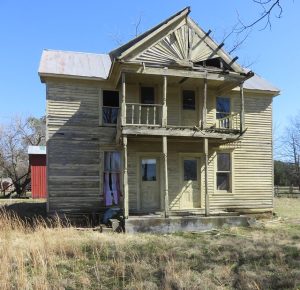
The Bacon (or Sunrise) Hotel is located in the small community of Whitehall, which is on Highway 1 about six miles south of Harrisburg. Built in 1912 by James William Bacon, the hotel is a rare surviving example of a Folk Victorian-style hotel constructed during the area’s timber boom. Because of its proximity to the railroad, the hotel originally catered to timber agents and traveling salesmen. After the land was cleared of timber, the economic boom subsided, making the building’s use as a hotel short-lived. From 1919 until the early 1950s, the William D. Roberts family used the building as housing for farm managers who tended to their agricultural holdings in the area. Listed in the National Register of Historic Places in 1995, the building has been vacant since the mid-20th century and suffers from long-term deterioration and neglect. The rehabilitation of the Bacon Hotel presents an opportunity to turn a vacant building into a community asset. With its location near the Parker Pioneer Homestead, the building could once again accommodate overnight guests as a boutique short-term rental or small hotel, catering to local customers and heritage tourists traveling along Crowley’s Ridge.
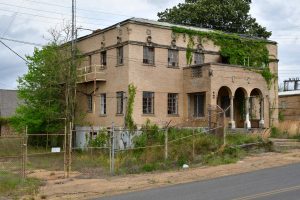
Designed ca. 1920 by the Little Rock architectural firm of Charles L. Thompson and Thomas Harding, Jr., the Columbia County Jail’s Renaissance Revival details mirror the county courthouse just one block away. Its design features a front portico with arched openings supported by Corinthian columns. Gargoyles are placed at each corner of the portico, and a stringcourse with shell detailing runs above the second story windows. It was listed in the National Register of Historic Places in 1984 as part of the Charles L. Thompson Design Collection Thematic Group. After serving as a jail for some 70 years, the building has been vacant and deteriorating since the 1990s. However, it recently sold, and the new owners intend to rehabilitate the historic jail. Its location in downtown Magnolia opens creative possibilities for future reuse.
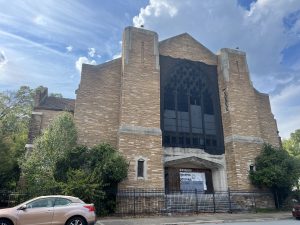
Located at the corner of 12th and Louisiana streets just north of the Governor’s Mansion Historic District, Little Rock’s historic First Baptist Church was built in 1941. It was listed in the National Register of Historic Places in 1994 as an excellent example of a church designed in the Collegiate Gothic style by Little Rock architect A. N. McAninch. After the congregation relocated, the former church was purchased by the nonprofit Ernie’s Museum of Black Arkansans or EMOBA, founded by Little Rock native Ernestine “Ernie” Dodson. EMOBA highlighted the achievements of black Arkansans and hosted programs for youth, but the organization has not been active at this property for several years, putting it at risk. This building was included on Preserve Arkansas’s Most Endangered Places list in 2018 after a partial roof collapse. Since then, the worst roof damage was repaired, but the building remains vacant and continues to deteriorate. Neighbors report vagrants accessing the property regularly, and a fire in the spring of 2026 caused additional damage. Ideally, this property would be rehabilitated and put back into active use. Given its National Register status and location near an active commercial corridor, the building’s rehabilitation for income-producing purposes would qualify for federal and state historic tax credits.
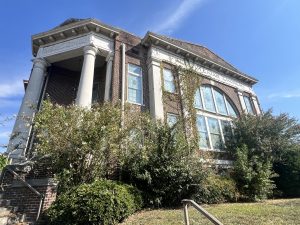
The historic First Presbyterian Church in Clarksville is located at the corner of N. College Avenue and W. Cherry Street between the city’s commercial historic district and the University of the Ozarks campus. The 1919 church was listed in the National Register of Historic Places in 1991 with statewide significance as the largest and best example of the Classical Revival style by architect A. O. Clarke. Of particular note are the building’s monumental entablatures reading “Presbyterian Church” and “Welcome,” along with its stained-glass windows and octagonal dome skylight above the sanctuary. Since 1891 when the Arkansas Cumberland College – now the University of the Ozarks – relocated to Clarksville, the Presbyterian denomination played an important role in the development of Clarksville and Johnson County. The historic church was built to accommodate a growing congregation and demonstrate the church’s strong commitment to community service. In 2017, with shrinking attendance, the First Presbyterian Church congregation made the hard decision to sell its historic building and hold services in the chapel at the University of the Ozarks. The historic church is currently on the market again and could qualify for preservation grants and historic tax credit incentives for rehabilitation.
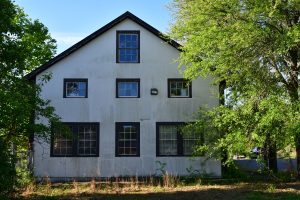
Built in 1933 by the 741st Company of the Arkansas District of the Civilian Conservation Corps, the Forest Service Headquarters Historic District in Hot Springs survives as the only complex of administrative buildings constructed by the CCC in the Ouachita National Forest. The district consists of six buildings designed in the Plain Traditional style with simple, unornamented walls and gable roofs. The buildings served as offices, woodworking and general maintenance shops, and vehicle garage and repair facilities. The district is significant for its association with the Civilian Conservation Corps and its mission to create jobs during the Great Depression while conserving and providing public access to federal lands. The buildings are currently unoccupied and suffer from deferred maintenance. The Forest Service is in the final stages of preparing the property for conveyance under the Forest Service Facility Realignment and Enhancement Act. As part of this process, the General Services Administration will oversee the sale of the property. The district and its buildings should be properly maintained for the future, when they could be rehabilitated to serve a wide variety of community purposes.

Located at the corner of Second and McNamee streets in Leachville, the Blytheville, Leachville & Arkansas Southern Railroad Depot was built about 1910. The railroad line connected local farmers to larger markets throughout the Mississippi Delta region. In 1929, the Blytheville, Leachville & Arkansas Southern Railroad was acquired by the Cotton Belt line. The depot was listed in the National Register of Historic Places in 1992. Years of vacancy and significant storm damage took their toll on the building, leaving it in a precarious state of disrepair by 2025, when the Leachville Beautification Commission identified the depot as a priority project. In early 2026, the Commission negotiated a land swap in order to gain ownership of the depot. The organization acted immediately to install a new roof and protect the depot from additional water intrusion. This was accomplished through a partnership with GAF, North America’s largest roofing and waterproofing manufacturer, who donated the materials, and Price Roofing, Renovations and Landscaping, who donated the labor to install the new roof. More work has been done since then, including repairs to exterior wood siding, exterior painting, and construction of an ADA-accessible ramp. However, much remains to be done before the building can be occupied, including window restoration, installation of new systems, and restoration of all interior finishes. Once completed, the depot will serve as a community space and business incubator.
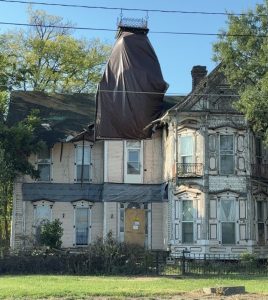
Located at the southeast corner of 6th Avenue and Plum Street in downtown Pine Bluff, the 1885 R. M. Knox House stands as one of the best remaining examples of Eastlake Victorian architecture in Arkansas. Richard Morris Knox moved to Pine Bluff after the Civil War and ran a successful mercantile business for more than three decades, making him one of the wealthiest men in the community at the time of his death in 1915. Generations of the Knox family occupied the house until the 1990s. Now in a dilapidated state, the home retains many of its original architectural features, including a mansard-roof tower topped with iron cresting, scalloped shingles, intricate woodwork, and decorative window surrounds. The Knox House was included on Preserve Arkansas’s Most Endangered Places list in 2011, and it is being included again to raise awareness of its significance and new efforts to save it. The nonprofit R. M. Knox Preservation Foundation was formed with the goal of purchasing and restoring the Knox House to serve as a community space and museum. They lack just $20,000 to own the house. In the meantime, the organization cleaned the interior of the house, removed overgrown vegetation and the collapsing front porch, repaired a portion of the roof, and tarped the tower to protect it. Because of these efforts, the Knox House may have a chance to be saved.
Thank you to our selection committee members!
Bart Stafford, Chair, Hot Springs
Elizabeth Eggleston, El Dorado
Holly Hope, Little Rock
Tim Varner, AIA, Fort Smith
Tom Wing, Van Buren
2025 List of Arkansas's Most Endangered Places
2024 List of Arkansas's Most Endangered Places
2023 List of Arkansas's Most Endangered Places
2022 List of Arkansas's Most Endangered Places
2021 List of Arkansas's Most Endangered Places
2020 List of Arkansas's Most Endangered Places
2019 List of Arkansas's Most Endangered Places
2018 List of Arkansas's Most Endangered Places
2017 List of Arkansas's Most Endangered Places
2016 List of Arkansas's Most Endangered Places
2015 List of Arkansas's Most Endangered Places
2014 List of Arkansas's Most Endangered Places
2013 List of Arkansas's Most Endangered Places
2012 List of Arkansas's Most Endangered Places
2011 List of Arkansas's Most Endangered Places
2010 List of Arkansas's Most Endangered Places
2009 List of Arkansas's Most Endangered Places
2007 List of Arkansas's Most Endangered Places
2006 List of Arkansas's Most Endangered Places
2005 List of Arkansas's Most Endangered Places
2004 List of Arkansas's Most Endangered Places
2001 List of Arkansas's Most Endangered Places
2000 List of Arkansas's Most Endangered Places
1999 List of Arkansas's Most Endangered Places